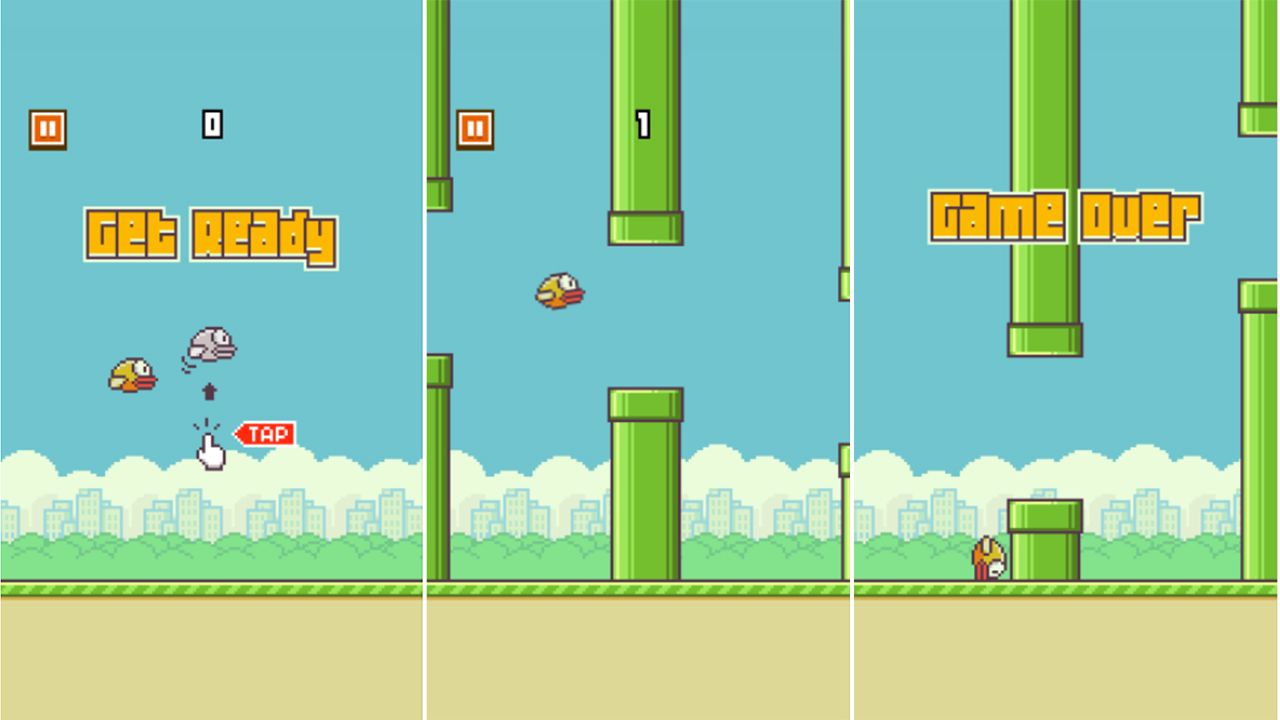
The infamous Flappy Bird game.
Introduction
Remember Flappy Bird? The notoriously difficult mobile game that took the world by storm in 2014? I decided to tackle it from a different angle: what if an AI could learn to play it perfectly?
This project uses NEAT (NeuroEvolution of Augmenting Topologies), a genetic algorithm that evolves both the structure and weights of neural networks. Unlike traditional neural networks where you define the architecture upfront, NEAT starts simple and grows complexity only when needed.
What is NEAT?

The genetic algorithm cycle: selection, crossover, mutation, and evaluation.
NeuroEvolution of Augmenting Topologies is an evolutionary algorithm developed by Kenneth O. Stanley in 2002. It solves three fundamental challenges in neuroevolution:
1. The Competing Conventions Problem
When two neural networks solve the same problem differently, how do you combine them? NEAT uses innovation numbers (unique identifiers assigned to each new connection) to enable meaningful crossover between different network topologies.
2. Protecting Innovation Through Speciation
New structural mutations often perform poorly at first. NEAT groups similar networks into species, allowing innovations time to optimize before competing against the broader population.
3. Minimizing Dimensionality
Rather than starting with complex architectures, NEAT begins with minimal networks and adds complexity through mutation only when beneficial. This keeps solutions as simple as possible.
Key NEAT Mutations
- Add Connection: Creates a new link between two previously unconnected nodes
- Add Node: Splits an existing connection, inserting a new hidden neuron
- Weight Mutation: Adjusts connection weights through perturbation or randomization
The Flappy Bird Challenge

The neural network receives game state information as inputs to decide when to flap.
Flappy Bird seems simple: tap to flap, avoid pipes. But it’s deceptively challenging because:
- Precise timing is critical. Flap too early or late and you crash.
- Constant decision-making. The bird must evaluate every frame.
- No recovery. One mistake ends the game.
This makes it a perfect testbed for AI: clear success criteria, simple inputs, and binary output (flap or don’t flap).
My Implementation
Game Setup
I built the game environment using Pygame with these parameters:
# Screen dimensions
SCREEN_WIDTH = 400
SCREEN_HEIGHT = 600

# Physics
GRAVITY = 2.0
FLAP_SPEED = 20
GAME_SPEED = 30

# Obstacles
PIPE_WIDTH = 70
PIPE_HEIGHT = 500
PIPE_GAP = 200

# Performance
FPS = 30
Neural Network Architecture
Each bird is controlled by a neural network that receives 4 normalized inputs:
| Input | Description |
|---|---|
bird_y / SCREEN_HEIGHT | Bird’s vertical position (0 = top, 1 = bottom) |
dist_to_pipe / SCREEN_WIDTH | Horizontal distance to the next pipe |
(gap_center - bird_y) / SCREEN_HEIGHT | Vertical distance to the center of the pipe gap |
velocity / 20 | Bird’s current vertical velocity |
The network uses tanh activation and outputs a single value. If output > 0.0, the bird flaps.
Network Evolution: Networks start with 4 inputs directly connected to 1 output (no hidden nodes). The initial connection is partial at 50%, meaning not all input-output pairs start connected. NEAT then evolves the topology, adding nodes and connections as needed.
Fitness Function
The fitness function guides evolution by rewarding good behavior:
# Survival reward (per frame alive)
genome.fitness += 0.001

# Passing a pipe successfully
genome.fitness += 5.0

# Bonus for reaching 20 pipes
if score >= 20:
    genome.fitness += 10.0

# Penalty for collision (ground, pipes, or out of bounds)
genome.fitness -= 4.0
This encourages birds to:
- Stay alive as long as possible
- Progress through pipes
- Excel by reaching high scores
Training Process

Multiple birds competing simultaneously. Only the fittest survive to reproduce.
Evolution Parameters
Using NEAT-Python, I configured evolution with:
| Parameter | Value |
|---|---|
| Population Size | 1000 birds per generation |
| Generations | 200 maximum |
| Fitness Threshold | 500 (terminates early if reached) |
| Compatibility Threshold | 2.2 for species grouping |
| Survival Rate | Top 30% reproduce |
| Elitism | 2 best organisms preserved |
| Max Stagnation | 12 generations before species removal |
Mutation Rates
| Mutation Type | Rate |
|---|---|
| Add Connection | 20% |
| Delete Connection | 5% |
| Add Node | 3% |
| Delete Node | 1% |
| Weight Mutation | 60% |
| Bias Mutation | 30% |
What Happens Each Generation
- Spawn 1000 birds, each with a unique neural network
- Run the game until all birds die
- Evaluate fitness scores
- Select the best performers
- Reproduce through crossover and mutation
- Repeat with the new population
Results
Training Milestones
| Generations | Achievement |
|---|---|
| ~5 | First bird passes a pipe |
| ~15 | Consistent score of 10+ |
| ~30 | Networks play indefinitely |
Observations
Early Generations (1-10): Birds mostly crash immediately. Some random mutations occasionally produce birds that survive a few seconds.
Middle Generations (10-30): Networks begin to understand the correlation between pipe distance and flapping. Survival times increase dramatically.
Late Generations (30+): Champion networks emerge that can play indefinitely. The evolved topology typically has 4-6 connections and 1-2 hidden nodes.
Key Takeaways
NEAT is Efficient. Starting with minimal networks and growing complexity only when needed produces elegant solutions.
Fitness Design Matters. The reward structure directly shapes what behaviors evolve. Small tweaks can dramatically change outcomes.
Speciation Preserves Innovation. Without speciation, novel mutations would be eliminated before they could prove their worth.
Large Populations Help. With 1000 birds per generation, there’s enough diversity for evolution to explore many strategies simultaneously.
Try It Yourself
The full source code is available on GitHub:
Running the Project
# Clone the repository
git clone https://github.com/nikankad/NEAT-games.git
cd NEAT-games/FlappyBirdAi

# Install dependencies
pip install -r requirements.txt

# Run Flappy Bird NEAT
python game/flappy.py
Note: For visualization features (network topology graphs, fitness plots), you’ll need Graphviz installed on your system.
Built with Python, Pygame, and NEAT-Python.